
Sparked by an article by Bob Thompson, titled You had me at “Treat Customers as People” about Kustomer, a new kid on the customer service block, I ventured to reach out to founder Brad Birnbaum and his team to get some more information. After all the customer quadrant of software is quite crowded, and a new company needs to offer good ideas to keep up and go beyond the incumbents, most of them being young companies as well. One of the basic questions that I had was: Do we need another customer service solution? After all, G2Crowd already lists 19 in their Help Desk grid; and these are only the ones that made it into the grid. Overall G2Crowd counts 78 solutions, excluding Kustomer. And quite some of them are quite strong. 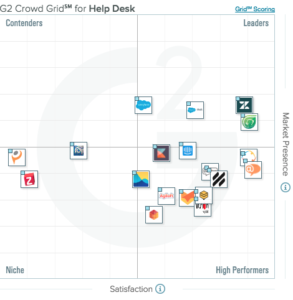 G2Crowd Grid Helpdesk, 12/2016 Figure 1: G2Crowd Grid for Help Desks as of December 2016 Brad and his team certainly seem to be of the opinion that there is an unmet need; as are their investors who brought in $ 12.5 million into seed- and series A funding in less than a year. The founders bring experience that dates back to 1996 and includes the success of Assistly, now desk.com, which is part of Salesforce. Another question is: How does Kustomer want to differentiate itself or, which issue do they solve that the other companies do not yet solve. Quite simply put, Kustomer claims that there are too many unconnected point solutions that customers – and hence employees – need to deal with. This issue gets addressed by the Kustomer platform that acts as an integration hub and connects customer service representatives to a multitude of communications channels; teams are enabled to ‘spend their days building meaningful relationships with customers and quickly and effectively solving their problems’. To accomplish this the team has built their user interface around the concept of the customer. Incoming support requests, regardless of the channel, are displayed by customer and not, as in other applications, by incident. When opening a customer all her incidents and conversations around these incidents are displayed in one timeline. The user interface allows for reply to the different channels. To emphasize on the focus on the customer Kustomer offers a simple sentiment tool that shows sentiment by customer and by conversation. Additionally, they offer a workflow engine that allows the automation of certain processes via configuration, as opposed to coding. Core objects can get enhanced and additional objects can get created – although I couldn’t test this feature, maybe due to the privacy tools that I installed on Chrome.
G2Crowd Grid Helpdesk, 12/2016 Figure 1: G2Crowd Grid for Help Desks as of December 2016 Brad and his team certainly seem to be of the opinion that there is an unmet need; as are their investors who brought in $ 12.5 million into seed- and series A funding in less than a year. The founders bring experience that dates back to 1996 and includes the success of Assistly, now desk.com, which is part of Salesforce. Another question is: How does Kustomer want to differentiate itself or, which issue do they solve that the other companies do not yet solve. Quite simply put, Kustomer claims that there are too many unconnected point solutions that customers – and hence employees – need to deal with. This issue gets addressed by the Kustomer platform that acts as an integration hub and connects customer service representatives to a multitude of communications channels; teams are enabled to ‘spend their days building meaningful relationships with customers and quickly and effectively solving their problems’. To accomplish this the team has built their user interface around the concept of the customer. Incoming support requests, regardless of the channel, are displayed by customer and not, as in other applications, by incident. When opening a customer all her incidents and conversations around these incidents are displayed in one timeline. The user interface allows for reply to the different channels. To emphasize on the focus on the customer Kustomer offers a simple sentiment tool that shows sentiment by customer and by conversation. Additionally, they offer a workflow engine that allows the automation of certain processes via configuration, as opposed to coding. Core objects can get enhanced and additional objects can get created – although I couldn’t test this feature, maybe due to the privacy tools that I installed on Chrome.