
Soon there will be an additional in-app customer service channel. So far we have a bunch of service channels, most of them requiring the user to leave the app to 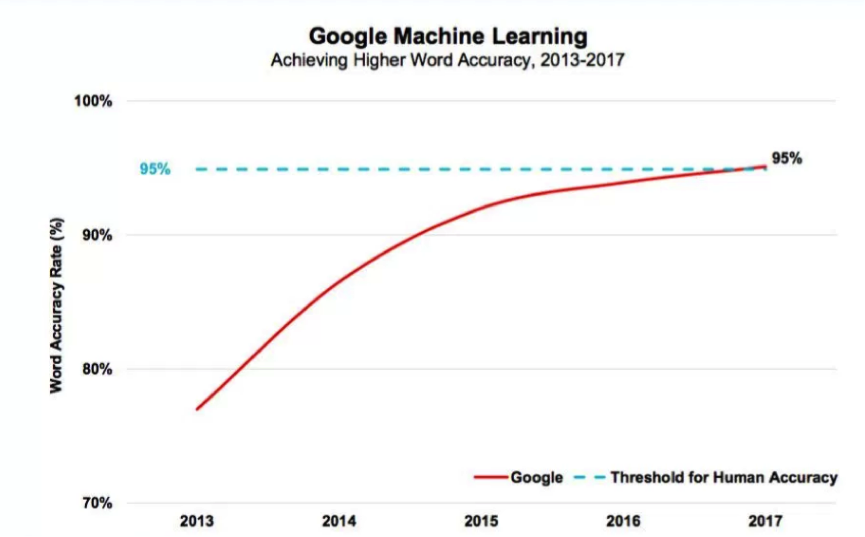 Machines arrive at human level of language understanding; source 2017 Internet Trends Report Machines arrive at human level of language understanding; source 2017 Internet Trends Report While Amazon doesn’t give any numbers on Alexa’s capabilities, Microsoft announced it reached a word error rate (WER) of 5.9 per cent in October 2016; IBM beat them to the punch with a WER of 5.5 percent in March 2017. And Google announced in May 2017 that it reached a WER of 4.9 per cent. Using speech recognition techniques on a level like this, in combination with natural language processing (NLP) and perhaps natural language generation (NLG), in-app service conversations can get both, very personal, and very immersive. And very effective. Speaking is the form of communication that comes easiest to humans. Speaking and conversations are tightly linked. Last but not least it is also a very efficient way of providing customer service as the human ability to exchange information is highest when speaking.
- Pick up the phone for a call
- Browse for self support
- Open up an additional chat window
- Take on the social media channels
- Move on to messenger applications
- How about getting into your car to get to a store?
- ...
Not Every Device is a Smartphone
But what if the customer cannot pick up the phone to engage in a typed conversation? The customer might be engaged in a VR game, or driving a car, or in any number of situations without having a free hand. Maybe the customer simply doesn’t want to pick up a phone? What if the app doesn’t offer a user interface at all beyond a little light that indicates ‘I am available’? This would e.g. be the situation in an ambient environment that senses the presence of a person and acts accordingly. An environment like this would mainly be voice and gesture controlled via devices like Amazon’s Alexa, Google Home, Apple’s HomePod, or Microsoft’s upcoming Home Hub. Systems like these will offer a keyboard as a secondary means to access service and support at best. But there is no need to look that far out. Imagine a gaming situation. Neither an Xbox, nor a Playstation, nor any other major controller offers a keyboard. In case of these or a VR or AR game the user would hold the controller and doesn’t have the leeway to get to a keyboard. So why would they offer a keyboard to enable conversational (or other) in-app support? There is no reason. Instead users will interact with the service system and –agent via gesture-, view- and speech based interfaces.The next In-App Support Channel is Voice
Voice recognition technologies are maturing rapidly and start to achieve human level accuracy in understanding at least English language. Human level of understanding lies at a word error rate (WER) of about 5 per cent, which means that a human on average gets five out of hundred words wrong due to misrecognition, missing a word, or falsely inserting one. Machines arrive at human level of language understanding; source 2017 Internet Trends Report Machines arrive at human level of language understanding; source 2017 Internet Trends Report While Amazon doesn’t give any numbers on Alexa’s capabilities, Microsoft announced it reached a word error rate (WER) of 5.9 per cent in October 2016; IBM beat them to the punch with a WER of 5.5 percent in March 2017. And Google announced in May 2017 that it reached a WER of 4.9 per cent. Using speech recognition techniques on a level like this, in combination with natural language processing (NLP) and perhaps natural language generation (NLG), in-app service conversations can get both, very personal, and very immersive. And very effective. Speaking is the form of communication that comes easiest to humans. Speaking and conversations are tightly linked. Last but not least it is also a very efficient way of providing customer service as the human ability to exchange information is highest when speaking.