
2016 has been predicted to be the year of conversational commerce, and I’d say that this prediction largely held true. Conversational interfaces have become more and more mainstream, and their support by AI and bots has become all the rage. While people more and more turn to their smartphones and Google to find service and get answers to their questions, companies are increasingly looking at bot support to increase the efficiency of their call centers. But where is reality? In their 2016 hype cycle on emerging technologies Gartner places 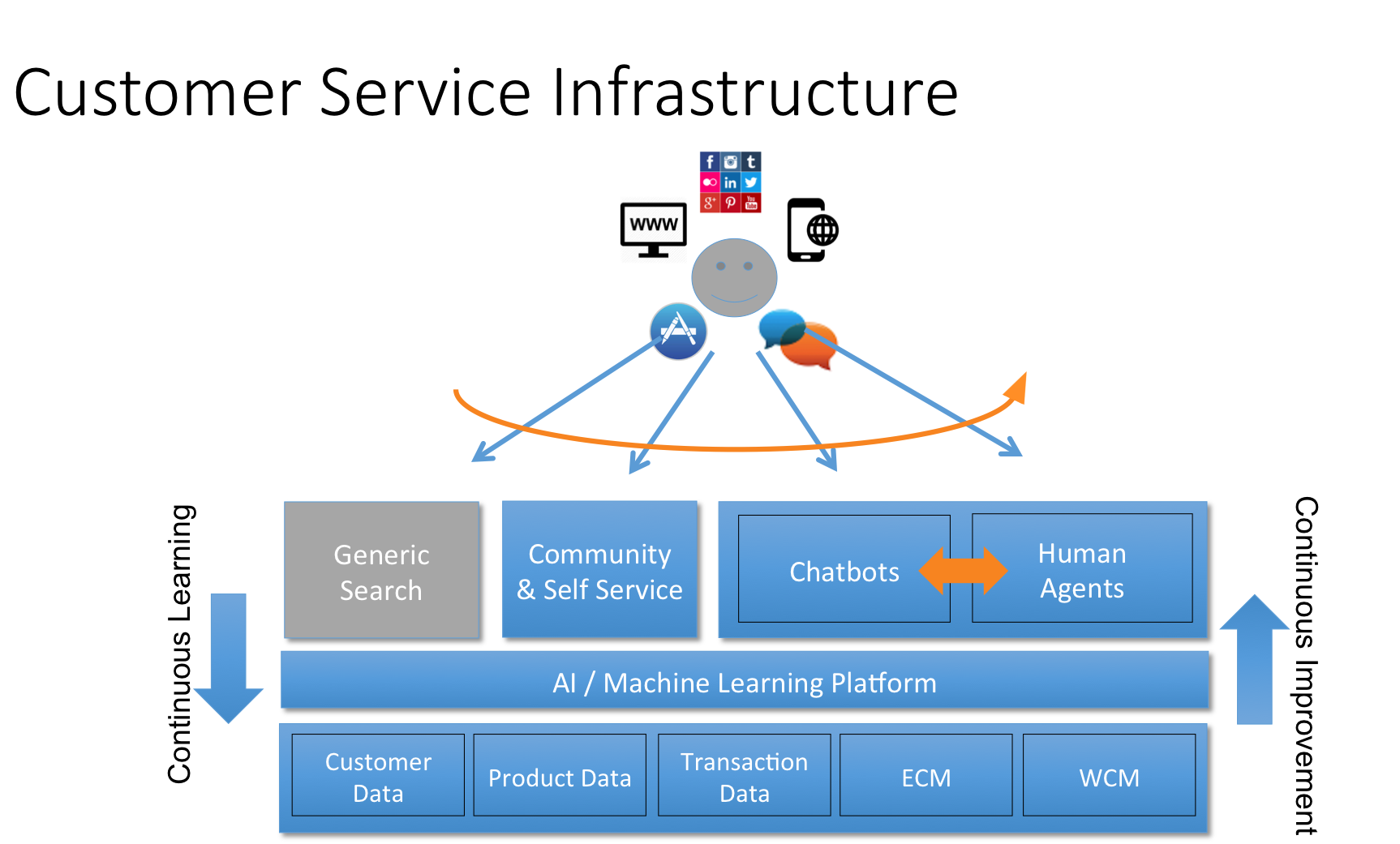 Once this foundation is in place, AI and bots can be deployed in a useful manner, first starting in a learning-only mode, then more and more engaging in customer initiated as well as company initiated interactions. These bots can ensure quick reaction; they gather missing relevant information can already offer solutions for the simpler problems. Minimally they keep the customer engaged and do a seamless handover to a human agent. This does not only help the customer, but the agent, too, as she is prepared and can dig right into the problem at hand. As the chatbots continue to be supported by a learning system they ‘learn’ from ongoing conversations and therefore the problems they solve can become increasingly complex. This fact, plus their ability to support the agent via continuously suggesting good solutions based upon the conversation flow and the knowledge base further increase the efficiency of the supporting agents who can increasingly support on more challenging problems instead of being in the need to ask repeatedly for the same information and answer the same ole questions over and over.
- Conversational UIs in the innovation trigger phase with a predicted time of 5 – 10 years to mainstream adoptions
- Machine Learning on the peak of inflated expectations with a period of 2 – 5 years to mainstream adoption
Once this foundation is in place, AI and bots can be deployed in a useful manner, first starting in a learning-only mode, then more and more engaging in customer initiated as well as company initiated interactions. These bots can ensure quick reaction; they gather missing relevant information can already offer solutions for the simpler problems. Minimally they keep the customer engaged and do a seamless handover to a human agent. This does not only help the customer, but the agent, too, as she is prepared and can dig right into the problem at hand. As the chatbots continue to be supported by a learning system they ‘learn’ from ongoing conversations and therefore the problems they solve can become increasingly complex. This fact, plus their ability to support the agent via continuously suggesting good solutions based upon the conversation flow and the knowledge base further increase the efficiency of the supporting agents who can increasingly support on more challenging problems instead of being in the need to ask repeatedly for the same information and answer the same ole questions over and over.