
In the past days two interesting articles around banks and banking innovation found their ways into my browser. One by Knowledge@Wharton on “How Banks Can Keep Up With Digital Disruptors” and the second one by Mobile Commerce Daily on “How four Australian banks are challenging Apple’s stranglehold on mobile payments”. The first article is essentially stating that banks are not using the “essential assets need to turn aside many of the assaults on their business now underway from fintech”, while the second one seems to sing the song of the poor banks that are held at a disadvantage by evil Apple. The four banks that challenge Apple are Bendigo and Adelaide Bank, Commonwealth Bank of Australia, National Australia Bank, and Westpac. Another large bank, ANZ Bank, cooperates with Apple by offering their customers to import cards into the Apple Wallet and using Apple Pay, and is not involved. But what do the banks want? According to the article they want access to “Apple’s Apple Pay system as well as access to the NFC capabilities of the iPhone”, being narrowed down to “require Apple to only disclose access to the NFC capabilities of the iPhone to the banks and therefore their customers.” Essentially they want to be able to build their own mobile payment system and not go through Apple’s wallet and still be present on “one of the most popular smartphones in the world” And yes, it is true that Google’s Android operating system allows more access to the phone’s NFC capabilities than iOS. On the other hand banks are seeing disruption coming. Fintech companies are coming up left, right, and center, attacking banks’ business models, offering payments, simple international transactions, advice, finance- and wealth management, lending services, even alternative currencies. The list goes on. 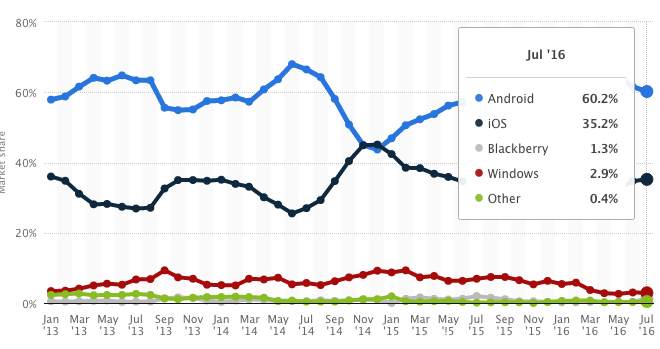 Australian Mobile OS Market Share Source: Statista Let’s assume that all of these are iPhones as the title suggests. In this case the banks to not have direct NFC access to about a third of all devices; in case this data covers both, iPhones and iPads, it is about half of this figure, which correlates to the worldwide sales data. Older Business Insider data about revenue distribution by country and platform shows about an even distribution of sales on iPhones vs. Android devices. The same article also observes a socio-economic split between iPhone and Android users in the US, a split in favour of iPhone. Simply put iPhone users are more affluent, although they seem to spend less per order than Android users. The Q4/2016 Monetate Benchmark report confirms this by finding an approximately 20% higher order value on iOS devices than on Android devices.
By the Numbers
Still, the question remains whether there is a ‘stranglehold’ that deprives the banks of their ability to compete. After all it seems possible to work with Apple, as evidenced by ANZ. Also, the market share of iPhones sales worldwide in Q4/2016 has been 18.3 percent (up from 12.4 percent in Q3/2016), according to Statista. As it turns out the market share of iOS devices in Australia is at around 35 percent in July 2016, again according to Statista. Australian Mobile OS Market Share Source: Statista Let’s assume that all of these are iPhones as the title suggests. In this case the banks to not have direct NFC access to about a third of all devices; in case this data covers both, iPhones and iPads, it is about half of this figure, which correlates to the worldwide sales data. Older Business Insider data about revenue distribution by country and platform shows about an even distribution of sales on iPhones vs. Android devices. The same article also observes a socio-economic split between iPhone and Android users in the US, a split in favour of iPhone. Simply put iPhone users are more affluent, although they seem to spend less per order than Android users. The Q4/2016 Monetate Benchmark report confirms this by finding an approximately 20% higher order value on iOS devices than on Android devices.