During SAPPhire 2018 SAP announced C/4HANA with quite a fanfare. I covered and analysed this announcement in my post SAPPHIRE 2018 – The Return of the Suite. Sure, C/4HANA marks the return of SAP to the suite, just in another shape than previously known. Instead of combining the pillars of CRM: Marketing, Sales, and Service in one monolithic application it integrates the corresponding clouds into a suite by means of an infrastructure-, service-, and integration layer called SAP Cloud Platform. The SAP Cloud Platform also provides services like IoT and Blockchain, besides numerous additional and less sexy, but necessary ones. 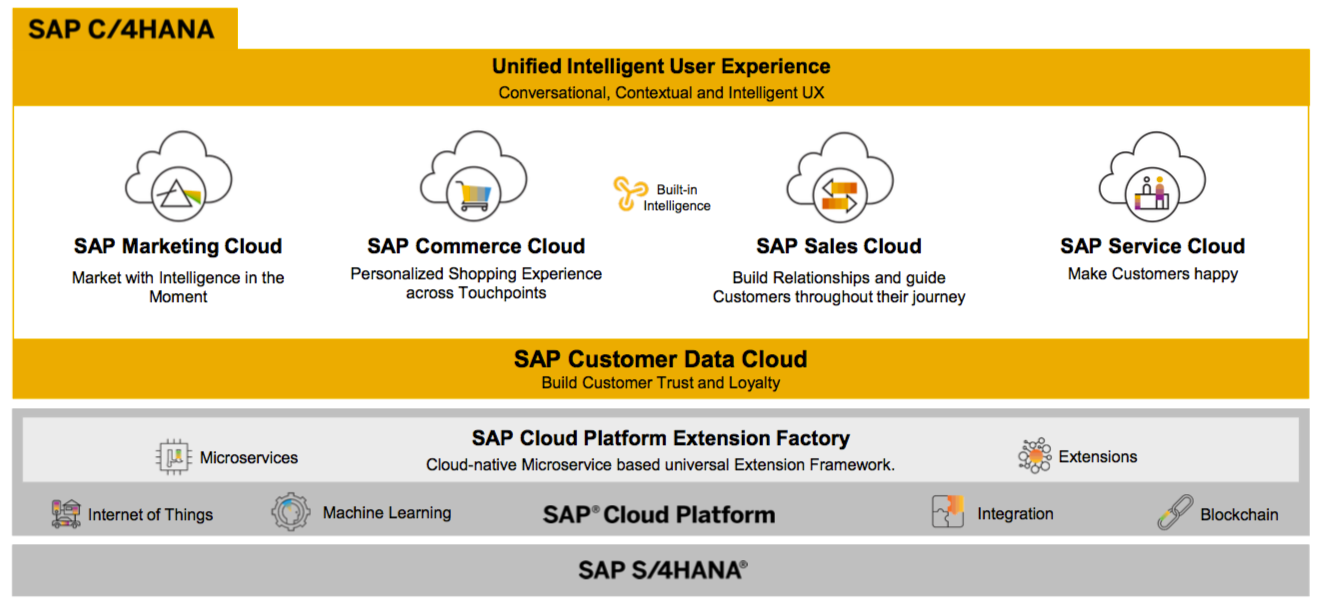 C/4HANA; source: SAP The SAP Cloud Platform also enables extensibility of the clouds, be it in-app (‘in cloud’) or as external extensions via the Extension Framework and the (upcoming) Microservices Ecosystem. The SAP Cloud Platform, as well as a number of in-cloud features enable AI and machine learning, exposed as intelligence that is embedded into the various clouds. Plus, the SAP Analytics Cloud – which is not explicitly mentioned as a part of C/4HANA, provides analytics abilities. Fiori as a user interface metaphor enables a consistent user experience. A chat bot infrastructure and the ability to run on all relevant screen sizes with one UI architecture pave the way towards keeping the user experience consistent. The addition of the SAP Customer Data Cloud hints into the direction of providing a customer data hub as a single version of the truth of things customer. As such, the SAP Cloud Platform is a modern reincarnation of SAP Netweaver. Reincarnation, not repetition, as it is ways closer to Hasso Plattner’s ideal of recombining business processes by just building them by drag and drop and connecting business objects declaratively. As an additional element we get the SAP Commerce Cloud, formerly known as Hybris Commerce. One now can argue whether e-commerce, even multi-channel e-commerce is a part of CRM, but this is not the right place nor time. SAP has taken the bold step of abandoning the Hybris brand in favor of brand harmonization and industry-known names. This is more than just laudable – and did I mention that this is bold? And the CRM industry, as well as the CRM community went beyond pure transactional CRM towards an entity that covers all aspects of engagement to deliver an experience. This mandatorily includes omni-channel e-commerce. I would even go a step further saying that it actually requires channel independent, or channel agnostic commerce. For a business, commerce is simply the objective of CRM. SAP has seen this early and positioned itself with the message ‘Beyond CRM’. Beyond CRM, because it is
 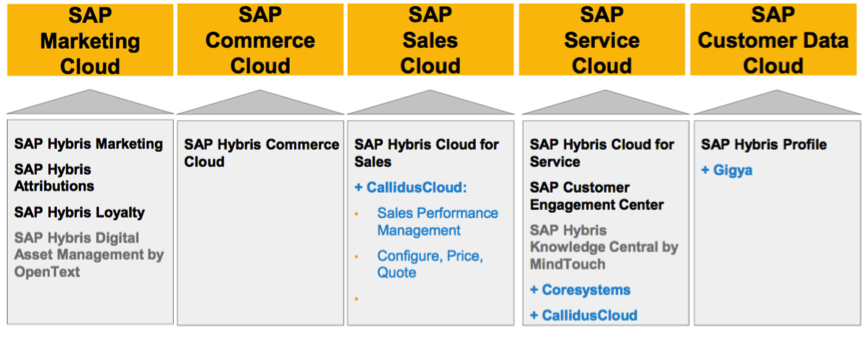 SAP Customer Experience; source: SAP Lastly, it shows that customer experience is close to the heart of SAP; close to, not at its core, as this is where S/4HANA is and needs to be. This closeness, as well as the ambition to take on the competition, is also shown by SAP breaking out C/4HANA numbers. I cannot remember SAP showing numbers of the SAP Hybris portfolio in the past years. But there are a number of open questions. Don’t get me wrong. I like this rebranding, in spite of – and perhaps, because of – the likeness of C/4 to C-4, which is a (infamous) plastic explosive. The similarity may or may not be intentional. Still, these questions, and probably more, need to be – and are – asked.
C/4HANA; source: SAP The SAP Cloud Platform also enables extensibility of the clouds, be it in-app (‘in cloud’) or as external extensions via the Extension Framework and the (upcoming) Microservices Ecosystem. The SAP Cloud Platform, as well as a number of in-cloud features enable AI and machine learning, exposed as intelligence that is embedded into the various clouds. Plus, the SAP Analytics Cloud – which is not explicitly mentioned as a part of C/4HANA, provides analytics abilities. Fiori as a user interface metaphor enables a consistent user experience. A chat bot infrastructure and the ability to run on all relevant screen sizes with one UI architecture pave the way towards keeping the user experience consistent. The addition of the SAP Customer Data Cloud hints into the direction of providing a customer data hub as a single version of the truth of things customer. As such, the SAP Cloud Platform is a modern reincarnation of SAP Netweaver. Reincarnation, not repetition, as it is ways closer to Hasso Plattner’s ideal of recombining business processes by just building them by drag and drop and connecting business objects declaratively. As an additional element we get the SAP Commerce Cloud, formerly known as Hybris Commerce. One now can argue whether e-commerce, even multi-channel e-commerce is a part of CRM, but this is not the right place nor time. SAP has taken the bold step of abandoning the Hybris brand in favor of brand harmonization and industry-known names. This is more than just laudable – and did I mention that this is bold? And the CRM industry, as well as the CRM community went beyond pure transactional CRM towards an entity that covers all aspects of engagement to deliver an experience. This mandatorily includes omni-channel e-commerce. I would even go a step further saying that it actually requires channel independent, or channel agnostic commerce. For a business, commerce is simply the objective of CRM. SAP has seen this early and positioned itself with the message ‘Beyond CRM’. Beyond CRM, because it is - Not only transactional but also covers engagement
- Includes all channels
- Transparently connects front- and back office
- And has an outside-in view of the process
SAP Customer Experience; source: SAP Lastly, it shows that customer experience is close to the heart of SAP; close to, not at its core, as this is where S/4HANA is and needs to be. This closeness, as well as the ambition to take on the competition, is also shown by SAP breaking out C/4HANA numbers. I cannot remember SAP showing numbers of the SAP Hybris portfolio in the past years. But there are a number of open questions. Don’t get me wrong. I like this rebranding, in spite of – and perhaps, because of – the likeness of C/4 to C-4, which is a (infamous) plastic explosive. The similarity may or may not be intentional. Still, these questions, and probably more, need to be – and are – asked.